 English
 Spanish
 French
 German
 Italian
 Chinese (Simplified)
 Japanese
 Korean
 Arabic
 Portuguese
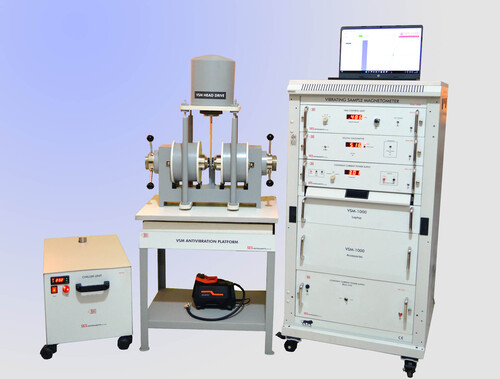


Vibrating Sample Magnetometer
Product Details:
- Material Electronics
- Application Laboratory Experiment
- Weight 300 Kg Kilograms (kg)
- Usage Laboratory Experiment
- Color Grey
- Display Type Digital
- Click to View more
Vibrating Sample Magnetometer Price And Quantity
- 1 Set
Vibrating Sample Magnetometer Product Specifications
- Digital
- Laboratory Experiment
- Electronics
- Laboratory Experiment
- Grey
- 300 Kg Kilograms (kg)
Vibrating Sample Magnetometer Trade Information
- Cash Against Delivery (CAD), Cash on Delivery (COD), Cash Advance (CA), Cash in Advance (CID), Cheque, Delivery Point (DP), Telegraphic Transfer (T/T)
- 100 Set Per Week
- 1 Week
- Contact us for information regarding our sample policy
- Complete in all respect
- Western Europe, Asia, Australia, North America, South America, Eastern Europe, Middle East, Africa, Central America
- All India
- ISO 9001: 2015 CE
Product Description
The SES Vibrating Sample Magnetometer (VSM) measures the magnetization of a sample of magnetic material under an external magnetic field by converting the dipole field of the sample into an ac electrical signal. A vibrator along with its electronics vibrates the sample with a fixed frequency and stabilized amplitude. The sample is driven to vibrate. Due to changes in flux, voltage proportional to the samples magnetic moment is induced in the pickup coils. By calibrating this voltage to magnetic moment using calibration standards and measuring the magnetic field, the magnetic moment of the sample can be obtained. The software controls the instrument and measures the magnetic moment. Hysteresis Loop can also be drawn through this software and its parameters calculated.
System Description
Magnetic Field System
- Electromagnet (Magnetic field is higher than 0.5T at gap of 25mm in iron cores)
- Dual polarity power supply
- Gauss Meter (Range: 20kGauss to 1Gauss)
- Embedded Magnetic Flux Detector
Control System
- Built-in computer systems (with Microsoft Windows)
- "Built-in Software Interface for Collecting and Analyzing the Data" (Hysteresis loops can be measured automatically to find the saturation magnetization, coercivity,and remanence of magnetic samples.)
- Built-in Data Acquisition System
Others
- Standard Computer with processor and original Windows10 loaded.
- Keyboard and Mouse
- Calibrations standard samples (99.9% Nickel and HgCo(SCN)4)
Precision Magnetic Measurement Made Easy
The VSM-1000 simplifies the study of magnetic characteristics by providing accurate, real-time data through its digital display. Its sturdy construction ensures stability during experiments, making it suitable for repeated laboratory use. Designed for reliability, this equipment streamlines complex measurements for researchers and professionals.
Designed for Laboratory Excellence
Engineered with cutting-edge electronics, the VSM-1000 stands out for its performance and durability in laboratory environments. Its ergonomic design facilitates smooth user operation, even during extended analysis sessions. As a trusted supplier in India, we deliver exceptional quality and support for all your magnetic measurement needs.
FAQs of Vibrating Sample Magnetometer, VSM-1000:
Q: How does the VSM-1000 Vibrating Sample Magnetometer operate in laboratory experiments?
A: The VSM-1000 works by vibrating a sample within a uniform magnetic field and detecting the induced magnetic moment. Its digital interface allows users to monitor and record changes in magnetization easily and accurately throughout their experiments.Q: What is the primary benefit of using a VSM-1000 in research applications?
A: The main advantage of the VSM-1000 is its ability to precisely analyze magnetic properties, helping researchers gain deeper insights into material behavior. Its reliable performance and digital display facilitate quick data interpretation, supporting high-quality research outcomes.Q: When should the VSM-1000 be used in a laboratory setting?
A: The VSM-1000 is ideal for use when investigating material magnetism, especially in physical, chemical, and engineering research projects. It is most useful when accurate, reproducible measurements of magnetic properties are required.Q: Where can laboratories obtain the VSM-1000 in India?
A: Laboratories in India can procure the VSM-1000 directly from recognized exporters, manufacturers, and suppliers specializing in scientific instruments. Our firm offers comprehensive support and delivery across the region.Q: What is the process for measuring magnetic properties with the VSM-1000?
A: To measure magnetic properties, place the sample in the machine, initiate the vibration mechanism, and observe the digital output. The system registers the magnetic response and delivers detailed readings, ensuring accurate experimental data.Q: How can users benefit from the digital display feature of the VSM-1000?
A: The digital display provides clear, real-time results during experiments, reducing interpretation errors and improving workflow efficiency. Users can easily track and record magnetic measurements, saving time in data analysis.
Price:
- 50
- 100
- 200
- 250
- 500
- 1000+

Other Products in 'Physics & Material Sc. Lab Experiments' category




- Building 452, Adarsh Nagar,Roorkee - 247667, Uttarakhand, India
- Phone : 07313725920

- Mr Ravi Prakash (Director)
- Mobile :07313725920
- Send Inquiry
- Landline : 91-1332-277118/ 272852
Direct No. :09837072750
 Send Inquiry
 Send Inquiry
 Send SMS
 Call Me Free
Developed and Managed by Infocom Network Private Limited.

