 English
 Spanish
 French
 German
 Italian
 Chinese (Simplified)
 Japanese
 Korean
 Arabic
 Portuguese
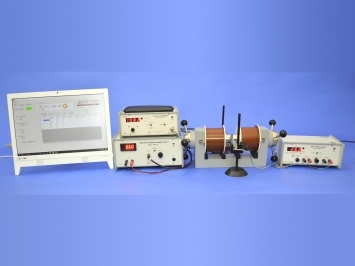
Hall Effect Experiment, HEX-21C
Product Details:
- Weight 60 Kg Kilograms (kg)
- Application Laboratory Experiment
- Usage Laboratory Experiment
- Color Grey
- Material Electronics
- Display Type Digital
- Click to View more
Hall Effect Experiment, HEX-21C Price And Quantity
- 1 Set
Hall Effect Experiment, HEX-21C Product Specifications
- Digital
- Laboratory Experiment
- Laboratory Experiment
- 60 Kg Kilograms (kg)
- Electronics
- Grey
Hall Effect Experiment, HEX-21C Trade Information
- Cash on Delivery (COD), Cash Against Delivery (CAD), Cash Advance (CA), Telegraphic Transfer (T/T), Delivery Point (DP), Cash in Advance (CID), Cheque
- 100 Set Per Month
- 1 Week
- Contact us for information regarding our sample policy
- Complete in all respect
- Asia, Australia, Central America, North America, South America, Eastern Europe, Western Europe, Middle East, Africa
- All India
- ISO 9001: 2015 CE
Product Description
Hall Effect Experiment, HEX-21C
We manufacture, export and supply Hall Effect Experiment Device in Roorkee, Uttarakhand, India.
Introduction
The resistivity measurements of semiconductors can not reveal whether one or two types of carriers are present; nor distinguish between them. However, this information can be obtained from Hall Coefficient measurements, which are also basic tools for the determination of carrier density and mobilities in conjuction with resistivity measurement.
As you are undoubtedly aware, a static magnetic field has no effect on charges unless they are in motion. When the charges flow, a magnetic field directed perpendicular to the direction of flow produces a mutually perpendicular force on the charges. When this happens, electrons and holes will be separated by opposite forces. They will in turn produce an electric field (Eh) which depends on the cross product of the magnetic intensity, H, and the current density, J.E h = RJ x HWhere R is called the Hall CoefficientNow, let us consider a bar of semiconductor, having dimension, x, y and z. Let J is directed along X and H along Z then Eh will be along Y.
Where Vh is the Hall voltage appearing between the two surfaces perpendicular to y and I=J yz
The set-up consists of following units:
- Hall Probe (Ge Crystal - n type)
- Hall Probe (Ge Crystal - p type)
- Hall Probe Multipurpose Stand, HPS-2pcs
- Hall Effect Set-Up, Model DHE-21C
- Electromagnet, Model EMU-50V )
- Constant Current Power Supply, DPS-50C
- Digital Gaussmeter, DGM-202C
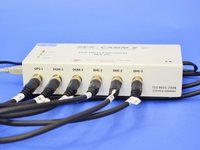
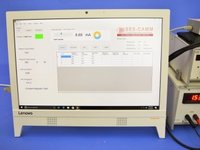
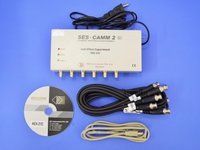
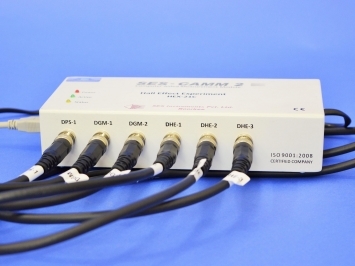
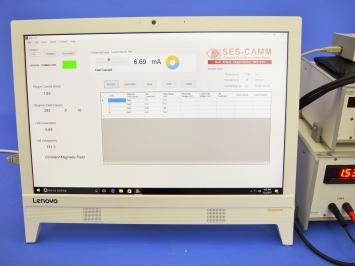
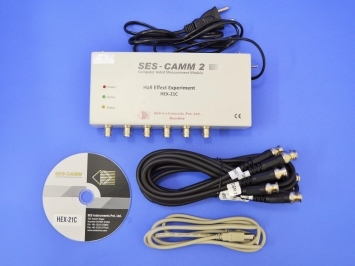
- Computer Aided Measurement Module, SES CAMM-2,
complete with suitable software Complete in all respect, except a computer
Advanced Instrument for Hall Effect Studies
The HEX-21C is engineered to facilitate comprehensive laboratory experiments on the Hall Effect, commonly used to investigate electronic properties of materials. Its robust build ensures stability, and the digital display enhances precision during experimental procedures. This setup is essential for physics and electronics research in academic institutions.
Reliable and User-Friendly Laboratory Equipment
With a streamlined design and intuitive operation, this equipment allows researchers and students to observe and quantify Hall voltage efficiently. The digital interface simplifies data collection, making it an ideal choice for laboratory demonstrations and educational uses.
FAQ's of Hall Effect Experiment, HEX-21C:
Q: How is the Hall Effect Experiment, HEX-21C, used in laboratories?
A: The HEX-21C is utilized to measure the Hall voltage generated across an electronic material when subjected to a magnetic field. This helps determine key parameters such as carrier concentration and mobility, essential for electronics research and education.Q: What materials and display type does the HEX-21C feature?
A: This instrument is constructed mainly from electronic components and is designed for durability and longevity. The device is equipped with a digital display, providing clear and accurate measurements during experiments.Q: When should researchers use the HEX-21C in their laboratory experiments?
A: Researchers and students typically use the HEX-21C when investigating fundamental properties of semiconductors, especially during physics and electronics laboratory experiments requiring precise Hall Effect measurements.Q: Where is the HEX-21C manufactured and exported from?
A: The Hall Effect Experiment HEX-21C is manufactured, exported, and supplied by leading electronics equipment providers based in India, ensuring international standards of quality and performance.Q: What is the process for conducting a Hall Effect experiment with this device?
A: To conduct a Hall Effect experiment, the sample is placed within the instrument, and a magnetic field is applied. The resulting Hall voltage is then measured digitally, allowing calculation of electronic properties of the material being tested.Q: What are the key benefits of using the HEX-21C in laboratory settings?
A: The HEX-21C offers precise digital measurements, reliable construction, and easy operation, making it an essential tool for laboratory experiments. It helps deepen understanding of electronic materials, benefiting both research and educational activities.
Price:
- 50
- 100
- 200
- 250
- 500
- 1000+

Other Products in 'Physics & Material Sc. Lab Experiments' category



- Building 452, Adarsh Nagar,Roorkee - 247667, Uttarakhand, India
- Phone : 07313725920

- Mr Ravi Prakash (Director)
- Mobile :07313725920
- Send Inquiry
- Landline : 91-1332-277118/ 272852
Direct No. :+919837072750
 Send Inquiry
 Send Inquiry
 Send SMS
 Call Me Free
Developed and Managed by Infocom Network Private Limited.

