 English
 Spanish
 French
 German
 Italian
 Chinese (Simplified)
 Japanese
 Korean
 Arabic
 Portuguese
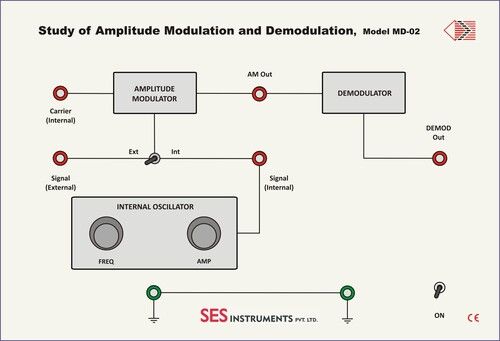


Study Of Amplitude Modulation And Demodulation, MD-02
Product Details:
- Size Standard
- Style Plain
- Use Laboratory Experiment
- Material Physics Material Science
- Shape Rectangle
- Color Grey
- Click to View more
Study Of Amplitude Modulation And Demodulation, MD-02 Price And Quantity
- 1 Piece
- 8900 INR/Piece
Study Of Amplitude Modulation And Demodulation, MD-02 Product Specifications
- Rectangle
- Standard
- Plain
- Physics Material Science
- Laboratory Experiment
- Grey
Study Of Amplitude Modulation And Demodulation, MD-02 Trade Information
- Cash on Delivery (COD), Delivery Point (DP), Cash Against Delivery (CAD), Telegraphic Transfer (T/T), Cash in Advance (CID), Cheque, Cash Advance (CA)
- 100 Piece Per Month
- 1 Week
- Contact us for information regarding our sample policy
- Complete in all respect
- Asia, Australia, Central America, North America, South America, Eastern Europe, Western Europe, Middle East, Africa
- All India
- ISO 9001: 2015 CE
Product Description
We manufacture, export and supply Experimental setup of Study Of Amplitude Modulation And Demodulation. Having strong bottom line growth and marketing strategies, we are engaged as manufacturer, supplier and exporter of Study Of Amplitude Modulation And Demodulation in Roorkee, Uttarakhand, India.
FEATURES
* Study of carrier signal testing.
* Study of variation of modulated wave with the modulation signal.
* Study of detector circuit.
* Built-in power supply
INTRODUCTION
The set-up consists of amplitude modulating and demodulating circuits. It is provided with a fixed frequency carrier of 60 KHz (approx.). A sine wave oscillator of suitable amplitude and frequency is available as the message however an external oscillator may also be used if needed. The basic experiment involves generating the amplitude modulated signal, calculating the modulation index at different message amplitudes and observing the waveform changes with message frequency. Also the demodulated signal is compared with the modulating signal under various conditions.
One of the interesting feature of the unit is the display of sidebands. The amplitude modulated wave is available in the time domain. Sidebands however are frequency domain description of the same signal. Traditionally fast fourier transform (FFT) has been used in Spectrum Analyzers to compute the frequency
spectrum of a time domain signal. Subject to the availability of a suitable Digital Storage Oscilloscope (DSO) it is now possible to display sidebands on its screen. The shifting of the sidebands with message frequency may also be studied on the unit.
An external oscillator may also be used to study non-sinusoidal messages like triangular or square wave.
The user manual supplied contains circuit diagrams and a brief description and suggestions on the experiments.
Comprehensive Amplitude Modulation Study
MD-02 grants users the ability to investigate the principles of amplitude modulation and demodulation in a controlled laboratory setting. Its straightforward design ensures reliable performance, making it ideal for student experiments and research projects. The grey rectangular device integrates well with various laboratory setups and meets the requirements of physics and engineering curricula.
Reliable & Practical Laboratory Instrument
Engineered with durable materials for physics and material science applications, the MD-02 maintains high accuracy during experiments. Its standard size and functional style provide ease of use, allowing laboratory professionals, educators, and students to focus on theoretical and practical learning in signal transmission and receiver analysis.
FAQ's of Study Of Amplitude Modulation And Demodulation, MD-02:
Q: How is the MD-02 used in laboratory experiments?
A: The MD-02 is employed to demonstrate and analyze amplitude modulation and demodulation processes, enabling users to visually and practically observe signal changes during transmission and reception in a laboratory setting.Q: What materials are used in the construction of the MD-02?
A: The instrument is constructed from robust physics material science components, ensuring durability and stability during frequent laboratory usage.Q: When should the MD-02 be incorporated into experiments?
A: It is best used during studies involving communication systems, electronic signal processing, and when exploring the fundamentals of amplitude modulation and demodulation as part of physics or engineering laboratory activities.Q: Where is the MD-02 manufactured and exported?
A: The MD-02 is manufactured and exported from India, making it accessible for institutions requiring high-quality laboratory instruments from reputable suppliers.Q: What is the process for performing amplitude modulation and demodulation with this instrument?
A: Users can connect the device to appropriate input and output terminals, use modulation sources, and observe how the instrument processes the amplitude variations. Demodulation can be then studied by analyzing the output signals for recovered information.Q: What are the benefits of using the MD-02 in academic laboratories?
A: Utilizing the MD-02 offers hands-on experience, improves understanding of communication principles, and supports effective demonstration, learning, and research in electronics and signal analysis.
Price:
- 50
- 100
- 200
- 250
- 500
- 1000+

Other Products in 'Experimental Setups ' category


- Building 452, Adarsh Nagar,Roorkee - 247667, Uttarakhand, India
- Phone : 07313725920

- Mr Ravi Prakash (Director)
- Mobile :07313725920
- Send Inquiry
- Landline : 91-1332-277118/ 272852
Direct No. :+919837072750
 Send Inquiry
 Send Inquiry
 Send SMS
 Call Me Free
Developed and Managed by Infocom Network Private Limited.

